Hire a Concrete Roof Repair Contractor Who Understands Florida Weather
A concrete roof repair contractor should be licensed, insured, experienced with concrete tile systems, and able to explain whether your roof needs a targeted repair, tile lift-and-reset, or replacement. For Florida homeowners, the right contractor should also understand wind uplift, storm damage, aging underlayment, salt air, and local permit requirements.
Before hiring, look for:
- Concrete tile experience: Concrete tiles are heavy and can break when walked on or removed incorrectly.
- A full inspection: The contractor should check tiles, flashing, underlayment, decking, and signs of hidden moisture – not just replace the visible broken tile.
- Active licensing and insurance: Verify Florida licensing, general liability coverage, and workers’ compensation protection.
- Clear written scope and warranty: Get itemized repair details, material information, permit responsibility, and realistic workmanship warranty terms.
- Storm-claim documentation: After wind or hail damage, choose a contractor who can provide dated photos and a detailed scope for your insurer.
Concrete tile roofs can often last 30 to 50 years, but the tiles are only one part of the system. A roof may look sound from the street while its underlayment, flashing, fasteners, or decking allow water into the home. That is why hiring a specialist matters – especially after a Florida storm or when a small ceiling stain keeps coming back.
I’m Byron Toups, founder of RoofPro Roofing, with more than a decade in roofing and storm-related insurance claim work across the Gulf Coast and Florida. My experience as a concrete roof repair contractor includes helping homeowners identify real roof failures, document damage clearly, and choose repairs that protect the home rather than hide the leak.

Signs Your Concrete Roof Needs Immediate Repair
Concrete roofs are renowned across Florida for their structural durability, yet even the sturdiest systems run into problems. Recognizing the early signs of damage helps prevent localized wear from transforming into severe structural wood rot. When moisture breaches the outer tile shell, ignoring it dramatically escalates the cost of a leaky roof.
Common indicators that you need immediate repair include:
- Displaced or missing tiles: High winds can lift loose tiles, exposing the waterproof felt beneath.
- Cracked or fractured concrete: Stress from falling tree limbs, thermal expansion, or improper roof traffic creates pathways for water.
- Deteriorated ridge mortar: The mortar pointing on hip and ridge caps naturally cracks and degrades under constant UV exposure.
- Roof deck sagging: Chronic moisture intrusion rots the underlying plywood decking, causing the roofline to dip under the extreme weight of the tiles.
- Attic water staining and mold: Dark water rings on rafters or wet insulation signal that the secondary barrier has failed.
- Heavy algae and moss build-up: While surface algae is common in humid areas, heavy biological growth holds moisture against the tiles and accelerates surface erosion.
- Corrosion from salt air: Coastal environments along Destin, Santa Rosa Beach, and Fort Lauderdale corrode metal valley flashings and mechanical fasteners over time.
Visible Tile Damage and Structural Deterioration
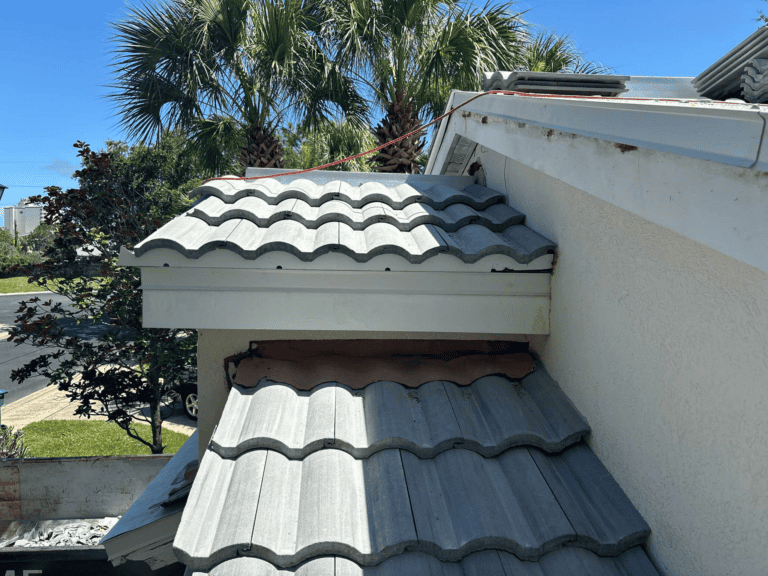
Surface damage to concrete tiles compromises more than just your curb appeal. When surface spalling occurs, water penetrates the porous aggregate of the concrete, leading to micro-fractures during sudden temperature drops. Damaged hip and ridge caps leave the apex of your home exposed to wind-driven rain, requiring professional broken roof tile replacement.

Additionally, wind uplift can dislodge individual pieces from their batten anchors, which calls for immediate slipped roof tile repair before adjacent tiles shift out of alignment. Because concrete roofing systems impose tremendous structural dead loads on your home’s framing, broken or slipping pieces must be addressed carefully by trained crews to avoid uneven weight distribution.
Hidden Underlayment Leaks and Moisture Infiltration
The outer layer of concrete tiles serves as a primary water-shedding shield, but the real waterproofing work happens beneath them. The underlying waterproofing barrier—traditionally asphalt organic felt or modern self-adhering modified bitumen—inevitably degrades from trapped heat and age. In Florida’s subtropical climate, organic felt can become brittle, crack, and delaminate after 15 to 20 years, even when the surface tiles remain in pristine condition.
When underlayment fails, wind-driven moisture slips beneath the tiles and seeps directly into the wooden roof deck. This hidden moisture infiltration often travels along rafters before appearing on your drywall, making the entry point hard to detect from inside the home. Left unaddressed, rotted decking compromises fastener withdrawal strength, leaving your roof highly vulnerable during hurricane season.
Understanding Concrete Tile Roof Repair vs. Full Replacement
Property owners often face a tough decision: should you patch the current leak, perform a restoration, or commission a full replacement? Evaluating the average roof lifespan in Florida alongside the age of your secondary barrier is essential to making a financially sound choice.
| Project Scope | Typical Lifespan | Primary Objective | Best Suited For |
|---|---|---|---|
| Spot Tile Repair | 1 to 5 Years | Address localized impact cracks or slipped tiles | Isolated damage on roofs with healthy underlayment |
| Tile Lift and Reset | 20 to 30 Years | Salvage existing tiles while replacing all underlayment and flashing | Sound concrete tiles with aged, failing underlayment |
| Full Roof Replacement | 30 to 50 Years | Complete tear-off and installation of new decking, barrier, and tiles | Brittle tiles, extensive storm destruction, or end-of-life systems |
Weighing roof repair vs roof replacement in Florida depends on whether the issue is isolated or system-wide. For multi-family and commercial properties in South Florida, structures approaching mandatory 40- or 50-year building recertifications must prove total structural deck integrity, making comprehensive restoration far more practical than temporary patches.
Spot Tile Repairs and Salvage Matching
Spot repairs are ideal when damage is restricted to a small, contained area—such as a fallen tree branch cracking a dozen tiles. However, sourcing replacement pieces presents a major hurdle because tile profiles, interlocking lugs, and color blends evolve. Many legacy concrete tile manufacturers from the 1980s and 1990s have updated their product lines or closed operations entirely.
A knowledgeable concrete roof repair contractor maintains a dedicated salvage network to source discontinued and obsolete profiles. By matching vintage profiles exactly, we maintain the interlock integrity of the roof without violating strict homeowner association (HOA) aesthetic bylaws. When replacing individual cracked tiles, contractors use specialized weather-rated polyurethane adhesives and elastomeric coatings engineered specifically for concrete applications.
Tile Lift and Reset vs. Complete Roof Replacement
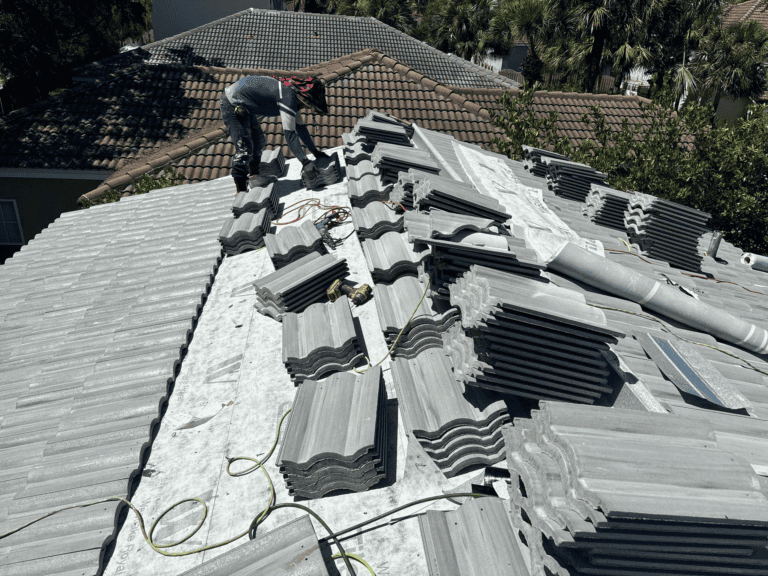
When the concrete tiles are structurally sound but the underlayment underneath has reached the end of its functional life, a tile lift-and-reset (often called a “tile reroof”) provides the ideal middle ground. During this process, our technicians carefully remove the existing tiles, number and stage them safely on the roof deck, strip away the deteriorated underlayment, inspect and replace rotted decking, and install a brand-new self-adhering secondary water barrier.
Once the new underlayment and heavy-gauge valley flashings are secured, the original tiles are reinstalled using modern foam adhesive or hurricane-rated fasteners. This method saves thousands of dollars in new tile manufacturing and disposal fees while providing a brand-new 30-year waterproofing warranty.
How to Vet and Select a Qualified Concrete Roof Repair Contractor
Selecting the right roofing partner requires careful diligence. Concrete tiles are dense and fragile; an inexperienced crew walking improperly on your roof can shatter sound tiles, creating more leaks than they fix. Learning how to find reliable roof repair protects you from fly-by-night operators who offer quick patches that fail during the first heavy rainstorm.
Essential Qualifications for a Concrete Roof Repair Contractor
When screening prospective contractors in Florida, confirm they possess the following qualifications:
- State Licensure: Verify that the contractor holds an active Certified Roofing Contractor (CCC) license through the Florida Department of Business and Professional Regulation (DBPR).
- Insurance Protections: Demand written proof of both General Liability insurance (minimum $1,000,000 policy) and full Workers’ Compensation coverage for all roofing technicians.
- Tile-Specific Walkability Training: Ensure their crews are trained in proper tile-walking techniques – stepping exclusively on the lower third (the reinforced lap) of flat or curved tiles using soft-soled shoes to prevent fractures.
- Building Code Knowledge: Your contractor must be fluent in the latest Florida Building Code standards, including mandatory uplift requirements in the Florida High Velocity Hurricane Zone (Miami-Dade and Broward counties) as well as the coastal wind provisions throughout the Panhandle and Gulf Coast.
Workmanship Warranties and Material Guarantees
Never accept vague oral promises regarding warranty protection. Professional contractors provide separate, written warranties covering both the materials used and the labor performed.
Be aware of industry realities: while full replacements and lift-and-reset restorations often carry workmanship guarantees of 5 to 25 years (alongside manufacturer warranties up to 50 years on select underlayment products), small spot repairs over old, brittle underlayment naturally have limited warranties. A reputable contractor will be transparent about what is covered – explaining clearly that patching one section of 25-year-old felt cannot guarantee adjacent sections won’t leak in the near future.
Navigating Insurance Claims and Storm Damage Restoration
Florida’s coastal corridors face powerful weather extremes, from tropical depressions to major hurricanes. When high winds tear off ridge caps or hail micro-fractures your concrete tiles, professional storm damage roof repair becomes necessary.
Understanding your roofing and home insurance coverage is vital to ensure your claim covers all necessary structural repairs under standard HO-3 policy terms.
Storm Damage Documentation and Florida Insurance Protocols
Filing a successful insurance claim after a storm requires meticulous, incontrovertible evidence. Following statutory changes to Florida property insurance legislation in 2023 regarding Assignment of Benefits (AOB) agreements, property owners are strongly encouraged to retain their direct claim rights rather than signing them away.
To protect your investment, a professional contractor will generate:
- Time-stamped, high-resolution photographs of all visible broken tiles, displaced hip caps, and damaged flashing.
- An itemized, insurance-compatible scope of loss using industry-standard pricing software (such as Xactimate).
- Written reports documenting hidden impact bruising, wind-chattered tile fasteners, and compromised underlayment.
- Accurate invoices detailing immediate emergency dry-in and water mitigation work.
If an insurer underpays or unfairly denies your claim, having this comprehensive engineering and photographic documentation allows you to invoke the formal appraisal clause in your policy to seek a fair settlement.
Emergency Response and Scope of Loss Estimates
When a major storm strikes, fast action prevents minor roof leaks from transforming into mold infestations. In areas across Palm Beach County, Destin, and Fort Walton Beach, emergency response teams should provide rapid-dispatch services—securing temporary waterproof tarps within hours of a storm’s passing.
Following emergency dry-in procedures, our technicians conduct non-destructive moisture scans and thermal imaging to map wet insulation beneath the tiles. This ensures that the scope of loss presented to your insurance adjuster includes full structural drying and wood deck restoration, rather than an inadequate surface-level patch.
The Step-by-Step Professional Repair Process
Executing a dependable concrete tile roof fix requires systematic precision. Our team approaches every residential repair with an emphasis on structural integrity, safety protocols, and long-term weatherproofing.
Comprehensive Roof Assessment and Leak Detection
A reliable repair always begins with an extensive diagnostic assessment:
- Initial Exterior Evaluation: Technicians use high-definition drone photography to evaluate overall roof geometry, ridge lines, and surface tile condition without immediately loading the roof with foot traffic.
- Thermal Infrared Scanning: Non-invasive thermal imaging identifies hidden moisture pockets trapped between the underlayment and the wooden deck.
- Flashing & Penetration Audit: Technicians inspect critical transitions, including valley pans, skylights, plumbing vents, and chimney flashings where water channels concentrate.
- Attic & Trusses Inspection: If accessible, we inspect the underside of the roof deck for dark water staining, rust on framing nails, or compromised truss plates.
How a Concrete Roof Repair Contractor Executes the Repair
Once the leak path is precisely located, our certified crews execute the repair using modern roofing methods:
- Tile Extraction: Technicians carefully remove the damaged concrete tiles and an extra perimeter of surrounding tiles to expose the entire underlying transition zone.
- Deck & Fastener Prep: Rotted decking is cut back to sound framing members, replaced with exterior-grade plywood, and fastened using hurricane-rated ring-shank nails.
- Self-Adhering Underlayment Application: A high-temperature, self-adhering modified bitumen underlayment is applied directly to the clean deck, creating a self-sealing secondary barrier around fastener penetrations.
- Batten & Flashing Rejuvenation: Treated wood or composite battens are installed with integrated weep holes to allow drainage, accompanied by new 26-gauge pre-painted metal flashings.
- Tile Reinstallation: Sourced matching concrete tiles are anchored back into position using specialized, hurricane-rated closed-cell polyurethane foam adhesive or stainless-steel mechanical fasteners.
- Mortar Pointing and Clean-Up: Ridge and hip connections are reinforced using fiber-reinforced, weather-rated masonry pointing, followed by full ground-level magnetic sweeps to collect stray nails.
Frequently Asked Questions About Concrete Roof Repair
How much does concrete tile roof repair typically cost?
Concrete tile roof repair pricing depends on several specific variables:
- Roof Pitch and Height: Steep-pitch multi-story roofs require specialized safety scaffolding and tie-off setups, increasing labor costs.
- Scope of Underlying Damage: A simple broken surface tile swap is very inexpensive, whereas addressing a 100-square-foot section of rotted plywood and degraded underlayment generally ranges from $1,500 to $4,500+.
- Tile Sourcing & Availability: Discontinued vintage concrete tiles sourced from salvage collections carry a premium compared to modern, in-production profiles.
- Accessibility & Location: Properties in high-density urban areas or coastal barrier islands may involve additional permitting and logistics expenses.
Can cracked concrete roof tiles be repaired instead of replaced?
Minor, hairline surface cracks can occasionally be bonded using elastomeric concrete sealants or flexible structural epoxies as a temporary fix. However, for long-term safety and water protection, replacing the cracked tile entirely is always the industry-recommended standard.
Concrete tiles expand and contract under Florida’s intense sun; thermal cycling rapidly breaks down surface adhesives on fractured tiles, eventually letting wind-driven rain reach the underlayment.
How long does a concrete roof repair last?
A professional repair executed with top-grade, self-adhering modified bitumen underlayment, new flashing, and polyurethane tile foam can easily last 20 to 30 years—matching the remaining life of your concrete roof.
Conversely, cosmetic surface patches using simple caulking or cheap roof tar typically fail within 12 to 24 months under intense UV exposure. Regular semi-annual inspections and prompt debris removal will help maximize the service life of your repaired roof.
Protect Your Investment with RoofPro Roofing’s Concrete Tile Specialists
Selecting the right concrete roof repair contractor is the difference between a permanent, weather-resilient roof and recurring ceiling leaks every time a storm rolls in. By prioritizing certified tile craftsmanship, proper underlayment restoration, and thorough insurance documentation, you protect your property’s value and structural security.
At RoofPro Roofing, our team brings specialized concrete tile expertise to homeowners and businesses across Florida—from Destin, Santa Rosa Beach, and Pensacola to Fort Lauderdale, Wellington, and North Port. As a GAF-Certified and Fortified Roof contractor, we build superior weather resilience into every project, backing our work with industry-leading lifetime workmanship guarantees.
Whether you need emergency storm damage mitigation, obsolete tile matching, or a complete lift-and-reset, contact our dedicated team today to schedule your comprehensive inspection and explore our expert residential tile roofing services.